Open Lecture on the SMI Service Package with the Use of AI Tools
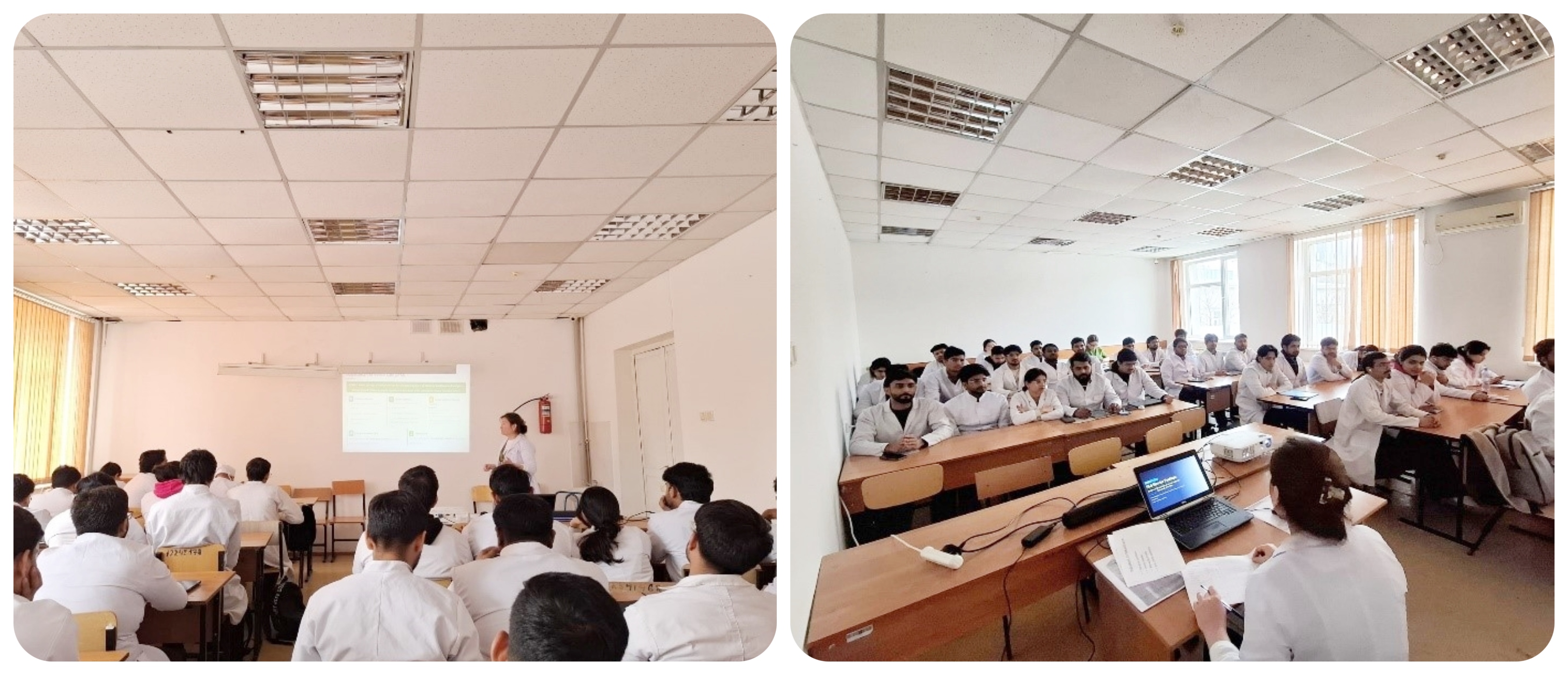
An open lecture was held at the Department of «Public Health and Healthcare» for 5th-year students of the educational program 6B10101 “General Medicine” within the discipline “Compulsory Social Health Insurance and Medical Law” on the topic:
“SMI Service Package. Features of Purchasing Services within the Framework of Social Medical Insurance.”
The lecture was conducted as part of the course CSHIML and aimed at developing students’ systemic understanding of the structure of medical care packages (State Guaranteed Benefit Package – GVFMC and Compulsory Social Health Insurance – CSHI), as well as the mechanisms for purchasing medical services within the mandatory health insurance system of the Republic of Kazakhstan.
The purpose of the open lecture was to develop students’ practice-oriented understanding of the principles of service package formation, patient routing algorithms, and financing mechanisms of medical services, as well as to demonstrate the possibilities of applying artificial intelligence tools in healthcare.
The lecture was organized in the format of a lecture-dialogue with elements of digital tool demonstrations and interactive feedback.
During the session, modern artificial intelligence tools and digital platforms were used:
• text-based AI assistant ChatGPT — for modeling insurance scenarios and analyzing access to GOBMP and CSHI packages;
• visual content generation using Gamma;
• demonstration of digital services of Kazakhstan (Qoldau 24/7);
• interactive platform Mentimeter — for real-time feedback and assessment of students’ understanding.
A special interest among students was generated by the practical block “AI Consultant for Insurance Cases.”
Prepared scenarios were used to simulate situations related to determining a patient’s insurance status and the available service package. Students analyzed cases (foreign students, individual entrepreneurs with contribution arrears, patients without residence permits, etc.) and, together with AI tools, formulated reasoned decisions.
It was emphasized that the final clinical and legal decision always remains with the physician. During the discussion, the following principle was highlighted:
“AI will not replace a doctor, but a doctor who uses AI will replace a doctor who does not.”
To increase student engagement, an interactive session was conducted via the Mentimeter platform. Students responded to questions regarding:
• differences between GVFMC and CSHI;
• patient routing algorithms;
• mechanisms of payment for medical services;
• opportunities and limitations of AI in healthcare.
The results demonstrated a high level of material comprehension and active student participation.
The open lecture confirmed the effectiveness of integrating artificial intelligence tools into the educational process. The use of digital technologies contributed to the development of students’ analytical thinking, AI literacy, and understanding of modern mechanisms of strategic purchasing of medical services.
The session highlighted the importance of innovative educational approaches in training future healthcare professionals.